
Who's Actually Winning the Transfer Portal?
By Scott Krotee
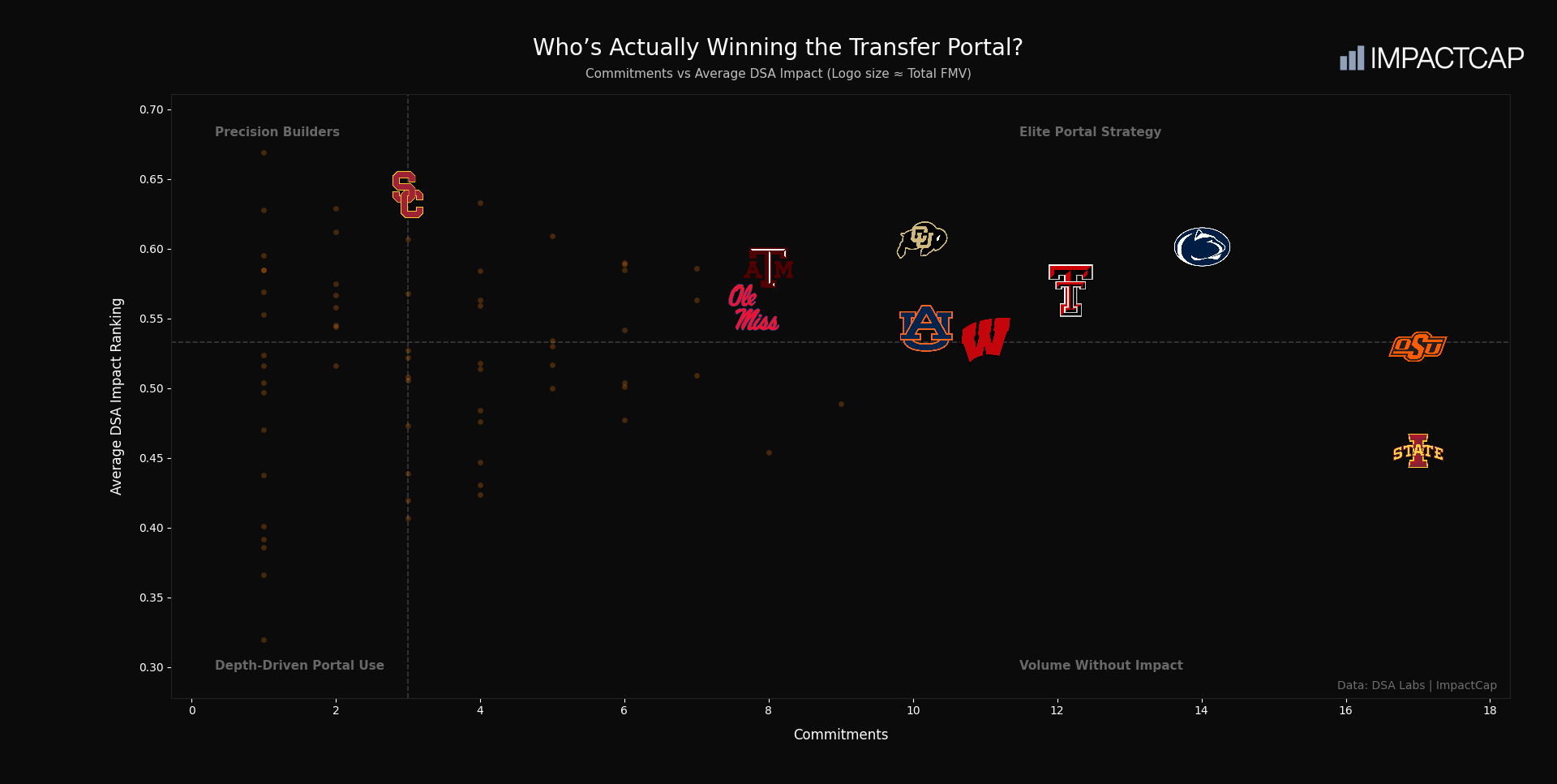
Analysis reveals which programs are actually upgrading their rosters—not just adding volume.
Every portal cycle, the conversation centers on one thing:
Who added the most players.
But volume doesn't win games.
Impact does.
Using DSA Impact Rankings (0–1) and DSA Fair Market Value, we analyzed every incoming transfer to see which programs are actually upgrading their rosters — not just filling spots.
What the data shows is a clear separation between three portal strategies.
The Real Portal Winners
Penn State — Precision Over Volume
- 14 commitments
- Avg DSA Impact: 0.601 (highest among major classes)
- Total FMV: $2.90M
Penn State isn't chasing headlines.
They're chasing impact density.
Their class isn't the biggest — it's the best on average. This is a program using the portal to raise its ceiling, not patch holes.
Takeaway:
Penn State treats the portal like a scalpel, not a net.
Oklahoma State — Capital Deployed Correctly
- 17 commitments
- Avg DSA Impact: 0.530
- Total FMV: $3.34M (highest overall)
Oklahoma State tied for the most additions and led the portal in total FMV.
That combination matters.
They didn't dilute quality while scaling volume — instead, they paired aggressive acquisition with above-average impact and real capital behind it.
Takeaway:
Oklahoma State isn't just active in the portal — they're investing in outcomes.
Colorado — High-Impact, Targeted Strikes
- 10 commitments
- Avg DSA Impact: 0.592
- Total FMV: $1.81M
Colorado's class is smaller, but extremely efficient.
One of the highest average impact scores in the dataset, driven by intentional targeting — not opportunistic adds.
Takeaway:
Colorado is quietly building leverage through precision.
The Volume Trap
Iowa State — Activity Without Impact
- 17 commitments (tied for most)
- Avg DSA Impact: 0.455
- Total FMV: $1.45M
This is what a depth-driven portal strategy looks like.
High volume.
Lower average impact.
Less capital concentration.
More roster filling than ceiling raising.
Takeaway:
Volume alone doesn't move the needle.
And it can dilute roster efficiency.
Other Notable Portal Classes
Texas Tech
- 12 commitments
- Avg Impact: 0.566
- $2.90M FMV
Strong balance of volume and quality — quietly one of the more complete classes.
Auburn
- 10 commitments
- Avg Impact: 0.551
- $2.15M FMV
Solid middle-ground strategy with meaningful upside.
Texas A&M
- 8 commitments
- Avg Impact: 0.586
- $1.42M FMV
Selective, efficient, high-signal.
The Big Picture
The transfer portal has split into three strategies:
- Volume Collectors — filling depth charts
- Capital Buyers — paying for certainty
- Impact Optimizers — maximizing value per roster spot
Only one consistently correlates with on-field improvement.
The portal isn't about who adds the most players.
It's about who adds the most impact.
Recruiting rankings measure hype.
Commitment counts measure activity.
DSA Impact Rankings measure outcomes.
That's how you see who's actually winning.
Explore ImpactCap Transfer Portal Rankings
See these analytics in action at ImpactCap.io. Access comprehensive transfer portal rankings, real-time updates, and advanced filtering tools powered by DSA Impact Rankings and Fair Market Value analysis.